THE KINTYRE
ANTIQUARIAN and
NATURAL HISTORY SOCIETY
MAGAZINE
Taken from
Issue Number 1 April 1977
CONTENTS
As a founder member and the first Honorary Secretary of the original Kintyre
Antiquarian Society, it gives me great pleasure to welcome the publication of this magazine. I am sure it will meet a long felt want, and I wish it every success in the future.
In an age when scholarship is at a discount and change is regarded by many, as synonymous with improvement, it seems to me that it becomes all the more important to look over our shoulders at the lives and achievements of our ancestors, for only by understanding the past can we prepare for the future.
This publication is an effort by the Kintyre Antiquarian and Natural History Society to give some permanence to the work done by our members in recording our past history and the natural features of our beautiful environment.
For over half a century the Kintyre Antiquarian Society as it originally was has held meetings where talks on all aspects of life in Kintyre were given. In addition many of these lectures were published, but are now out of print. The Society's Library contains a large collection of books and manuscripts relating to Kintyre. Recently subcommittee of the Society was formed to go into the question of making new and old material available to its members and others. This Magazine, which it is hoped to publish twice a year, is the result.
In this, our first number, we have included a variety of articles, touching on topics of interest to members. Much interest has always been shown by, the descendants of Kintyre emigrants in this district, and perhaps this periodical will appeal to them also. In our limited space we have been unable to touch on all the many facets of the work of the Society, but we hope to repair some of our omissions in succeeding Issues. Meantime perhaps some of our readers will be inspired to send contributions for other numbers. These could be anecdotes as well as full length articles. We aim to record the present before it becomes past and forgotten.
The Editor thanks the members of the sub-committee and in particular the Chairman, who has shared the editorial task; all who have contributed; the Editor of "The Kist" of the Natural History & Archaeological Society of Mid Argyll, without whose help this Magazine would not have got going; and the Editor of "The Glynns" of the Glens of Antrim Historical Society for understanding and encouragement.
And lastly, we thank our subscribers, and hope that they will bear with our omissions and errors, and that they will enjoy reading our Magazine.
On 14th June, 1921, the then Macdonald of Largie (father of the present Laird) and
Sheriff J. MacMaster Campbell issued a circular letter convening a meeting in the
Argyll Arms Hotel on 21st June, relative to the proposed formation of a society for the study of the Archaeology, History and Antiquities of Kintyre, and the preservation of the older records of the district.
The gentlemen convened were Col. Charles Mactaggart, Col. George Rome, Dean of, Guild
MacArthur, ex-Provost James Lothian, Dr. J. P. Brown, Rev. C. McEachern, Rev. A. MacKenzie, Messrs. T. Galloway, Latimer MacInnes, D. MacKinlay and Duncan Colville. Of these founder members only one is still with us - the venerable Mr. Duncan Colville, Life President of our Society, now in his 93rd year. At the first A.G.M., two ladies, Miss Moira Campbell, only recently deceased, and the late Mrs. Archd. Stewart, mother of our President, were admitted to membership.
Right away in its first year, the Society inaugurated what was to become a regular feature, an annual outing to some place or places of archaeological Interest. The first was to Largie and Clachan districts, followed by lunch at the Temperance Inn at Clachan, and by tea at Largie Castle.
Mr. Duncan Colville was appointed first Hon. Secretary and Treasurer. Largie was the first President, but he died in his first year of office and was succeeded by Sheriff J. MacMaster Campbell, who remained President until his death in 1939.
In April 1932, was admitted to membership the Rev. Father Webb, who, when he died in 1974, bequeathed a generous legacy to the Society, as well as all his antiquarian, historical and archaeological papers, which are currently being edited by Dr. Eric Cregeen.
The meetings of the Society were suspended in 1940 "until," as the minute says, "the war is over."
The
first meeting after the war was on 19th October, 1946, but the Society did not regain its vigour for some time. Two members, however, were very active and all enquiries relating to the antiquities of Kintyre were referred to them. Mr. Colville and Pr. Webb were both active archaeologists, and continued to further the aims of the Society. Father Webb, for example, took advantage of the excavations made in preparing the ground for pre-fabricated houses at the Calton site in 1947. More than 400 flints were found, and other relics, which constitute, as one authority has said, "the earliest unambiguous remains of man in Scotland." "The dwellers in these 'prefabs' wrote Father Webb in characteristic fashion, "had the honour of living upon the occupation site and working stance of the first human inhabitants of Scotland at a remove of something like 8,000 years."
In 1962, Mr. Frank Bigwood, a master at the Grammar School, excavated a fort at Kildalloig.
This highly commendable piece of amateur excavation was carried with the ready assistance of the School and of our Society, and the results can be seen, fully detailed and documented, in the local museum.
In 1969 the Secretaryship was taken over by Mrs. Margaret Macaulay. Regular meetings were held and the membership took a great leap forward. It was decided in 1970 to widen the aims of the Society, and its title was changed to "Kintyre Antiquarian and Natural History Society." Mrs. Macaulay, unfortunately, had to leave Kintyre in 1970, and the Secretaryship was taken over by Mrs. Elfric Wotherspoon, who still holds that office and whose unobtrusive management keeps the Society together.
In its fifty-five years of life, the Society has provided a focal point for the people of Kintyre who have an interest in the history of their district. It has nourished this interest for over two generations, and hopes to enlist the further support of all Kintyre people who realise that the present is a product of the past.
In 1970 some former farm land on the right hand side of the old avenue Into Stronvaar House was being prepared for building. This land was owned by the McGrory family of the former Kintyre Nurseries, and while bull-dosing the land, Mfc. X. McGrory discovered a Bronze Age Cist. His bull-dozer had badly damaged the Cist, but fortunately Mr. McGrory realised the value of his discovery, stopped work, and contacted the late Father Webb and Mr. Duncan Colville, Kintyre's most able historians, who photographed the remains of the cist and made all possible notes on the discovery.
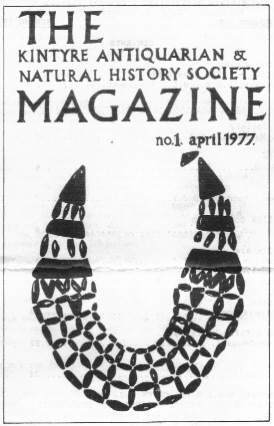
Father Webb contacted Dr. E. J. Peltenburg, the extramural Tutor for Argyll, whose archaeology class was just starting for the winter. On his first visit, Dr. Peltenburg found over one hundred Jet Beads, the skeleton which had been wearing it having crumbled to dust. Later when he and his extra-mural class visited the site with sieves and riddles, several more beads were found, and also a flint knife. After treatment with preservatives in Glasgow, the necklace was reconstructed and proved to be the longest ever found in Argyll, and consisted of 134 beads. The necklace was to have remained in Edinburgh at the Rational Museum of Antiquities, as it was one of the finest examples of a jet necklace the authorities there had seen. Those who had shared in the work of discovery felt that their find should remain permanently in Campbeltown, and due to the tireless efforts of Miss Cissy McGrory the necklace and the flint knife were returned to the Campbeltown Museum, where they are displayed In a burglarproof case.
The necklace belongs to the Bronze Age Period*, roughly 1800 - 1500 B.C., and the jet is believed to have been imported from Whitby, although a more local source may yet be found. So far ten necklaces of this type have been found in Argyll, but this is the only one on display in the place where it was found. Others are in museums in Glasgow and Edinburgh, and one found in Campbeltown years ago is In Inveraray Castle.
Note: The front cover shows a drawing of this necklace.
In Kintyre, as compared with other parts of the
Highlands and Hebrides, there is no history of forced
Clearances. And yet, from about 1750 to the present century
large numbers of people regularly left the district,
seeking a better living overseas. For example round 1750
the population of Southend was approximately 3,000. When my
father became minister of the parish In 1910 it had
dwindled almost to its current level of about 500.
In a paper published In 1962 (reprinted In 1964) by the
State Department of Archives and History in North Carolina,
concerning men and women from Kintyre who had settled there
In the years 1774 and 1775, the following reasons are given
for their emigration: "Low wages, high rents, low
prices of cattle, high prices of bread due to distilling ,
the conversion of arable lands into sheep pastures, and the
exactions of landlords."
(The wheat was a valued ingrediant of Whisky.
HR)
Around the rocky shores of Southend there can still be
seen, grass-grown and deserted, the ruins of townships from
which some of those people came. Balmagomery, Balmavicar,
Balimacmurchle, Bailevearhil (township of Mac Michael),
Balimackleconalich (township of Conley's son),
Balinamoll - the names are like an old song sighing down
the wind. Today such places appear to be of interest only
to local shepherds and to the Royal Commission on the
Ancient Monuments of Scotland.
But when strangers from abroad come visiting, sometimes
an old song can acquire a new and vigorous tune. In the
summer of 1975 Mrs. Harvey B. Hunter of Charlotte, North
Carolina, unexpected dropped in to see us. She was
accompanied by her daughter-in-law, a lecturer in history
at the University of North Carolina.
Mrs. Hunter is a formidable lady, eighty years of age,
who, with the help of two sons, conducts the business of a
large dairy farm. At the gate of her house, she told me, in
an attractive Southern accent which I had imagined existed
only in the movies, there stands the model of a cow, twenty
feet high.
She and her daughter-in-law had less than three hours to
spare. Could I in that time, give her any Information about
her ancestor, Daniel Caldwell, who had emigrated from
Southend in 1774? She showed me a copy of the testimonial
to his good character which he had carried with him to
America. It was signed by David Campbell, minister of
Southend, and John Raid, elder.
We stood on my lawn, looking out over the sunlit bay at
the Rock of Dunaverty and at the old jetty which lies close
to it. American hustle is all very well, but this was
ridiculous. Suddenly, however, the name sparked off a
memory of something I had read in Andrew McKerral's
book, "Kintyre in the Seventeenth Century." I
went into the house and looked up the reference; and there,
sure enough, was a master clue. In 1774 the Caldwells had
been tenants in the farm of Christlach.
I went back out on to the lawn, where the ladies were
talking to my wife and admiring our roses. They reckoned
they were better roses than they themselves could grow in
North Carolina. Delighted by such evidence of American
magnanimity, I cut two of the best blooms and presented
them with one each. I looked over the bay again at the
jetty near Dunaverty, and another memory occurred to
me.
"Do you know the month in 1774 when Daniel Caldwell
left Southend?"
"August," said Mrs. Hunter.
"The ship, he sailed in, was she by any chance the
Ulysses?"
"Say, that was the very name! How did you
know?"
I knew (or thought I knew) because a story about the
Ulysses used to be told in Southend: how she had anchored
in the bay while emigrants were taken out from the jetty in
a small boat, and someone on the shore had played a lament
on the bagpipes.
"It is possible," I told Mrs. Hunter,
"that your ancestor sailed for America from out there,
less than half a mile from where you are standing
now."
She found words difficult. Her daughter-in-law made
notes and worked hard with her camera.
"Now then " I said "we'll use my car
and have a look around." I stopped first at the
graveyard at Keil, where I
showed them the gravestone of John Reid, the elder who had
signed Daniel Caldwell's testimonial. I told them that
his descendants still live in the parish, and that a modern
John Reid is a friend of mine.
Mrs. Hunter was all eyes, scrambling about the knolls
and hollows of the ancient burying place like an
adolescent. I admired her fitness and said so. "I can
still take a ladder and repair the roof of our chicken
run," she announced, somewhat tartly. Her
daughter-in-law took more photographs.
Then I drove them three miles north to Christlach Farm,
where Daniel Caldwell had tried to help the meagre family
income by working - without much success, it appears - as a
part-time shoemaker. More photographs were taken .
Mrs. Hunter sighed. "Just wait," she said.
"Just wait till I tell them about this back home
!"
Finally we went to the church: St. Blaan's Kirk in
the centre of the parish. I told them it had been built in
1773 and opened for public worship early in 1774. I
explained that the pews of Norwegian pine were the original
ones, adjusted in numbers, but otherwise unchanged for more
than 200 years.
While her daughter-in-law made still more notes,
sunlight from one of the small, lead paned windows cast a
golden brown light over the old pews.
"Your ancestor, Daniel Caldwell, was obviously a
good church-goer otherwise he wouldn't have got a
testimonial signed by both the minister and an elder. In
the early part of 1774, therefore he must often have sat in
these very seats."
Mrs. Hunter sat down carefully on the polished pine.
"Two hundred years doesn't seem such a long
time now," I remarked.
She said nothing, staring up at the empty pulpit.
Then, quietly, she began to cry, "Oh, my," she
said, this is the most wunnerful day of ma life!"
It was a wonderful day for me, too.
When Mrs. Hunter returned to North Carolina she sent me
a letter, enclosing Photostat copies of the "Records
of Emigrants from Scotland", transcripts of which are
in the possession of the North Carolina Historical
Commission. From these it appears that among the emigrants
from Kintyre who, on 18 August 1774, sailed with Daniel
Caldwell in the "Ulysses" (James Chalmers,
master) were the following, all of whom gave as their
reason for emigrating either "high rents and
oppression" or "poverty occasioned by want of
work":
John Greenlees, 25, farmer, and his wife, Mary Howie,
25;
Peter McArthur, 58, farmer, his wife, Chirst Bride, 52,
and their children, Ann, John and Jean;
Robt Mitchell, 26, tailor, and his wife Ann Campbell,
19;
Alexr Allan, 22, workman;
Iver McMillan, 26, and his wife, Jean Huie, 23;
John Perguson, 19, workman;
Rob McKlchan, 32, farmer, his wife, Janet McKendrick, 24,
and their son, Neil;
Malm McMullan, 58, farmer, his wife, Cathn McArthur, 58,
and their children, Daniel, Archd, and Gelbt;
Donald McKay, 20, tailor,
Daniel Campbell, 25, farmer;
Andw Hyndman, 46, farmer, his wife, Cathn Campbell, 46,
and their children, Mary, Margt and Angus;
Malm Smith, 64, his wife, Mary McAlaster, 64, and their
children, Peter and Mary;
Duncan McAllum, 22, and his wife, Cathn McAlester,
30;
Neil Thomson, 23, farmer;
David Beaton, 28, farmer, and his wife, Flora Bride,
29;
John Gilchrist, 25, farmer, and his wife; Marion Taylor,
21;
Neil McNeil, 64, farmer, his wife, Isobel Simpson, 64,
and their children, Danl, Hector, Peter, Neil, Wlllm and
Mary;
Allan Cameron, 28, farmer;
Angus Cameron, 18, and his wife Katrine Cameron, 21.
Copyright belongs to the authors unless
otherwise stated.
The Kintyre Antiquarian & Natural History Society was
founded in 1921 and exists to promote the history,
archaeology and natural history of the peninsula.
It organises monthly lectures in Campbeltown - from October
to April, annually - and has published its journal,
'The Kintyre Magazine', twice a year since 1977, in
addition to a range of books on diverse subjects relating
to Kintyre.
CLICK HERE for Correspondence and Subscription Information.
 150
150


 E Mail